
Technology Report
October 19, 2026
Ayudag-6
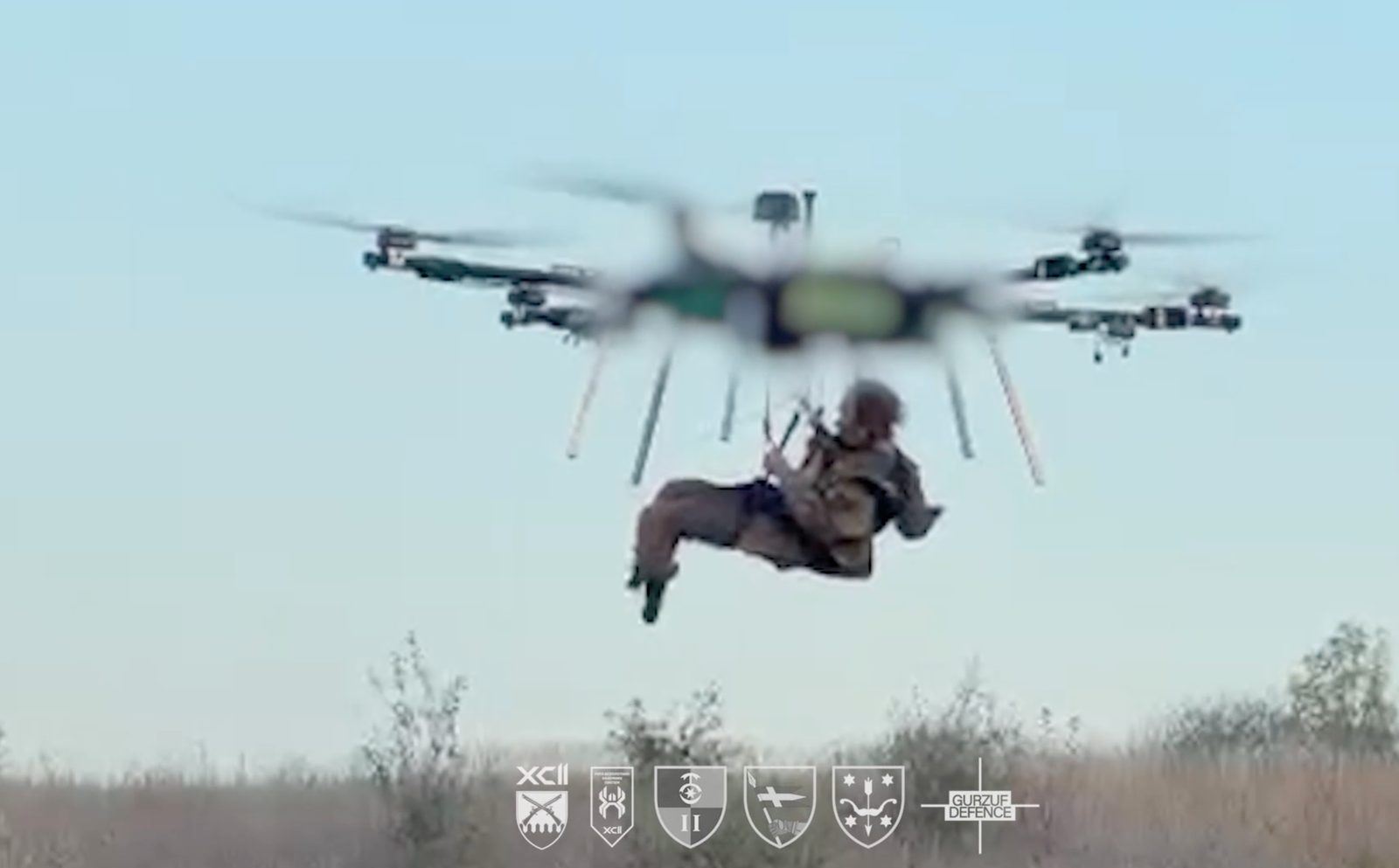
For months, the way Ukraine pulls wounded soldiers off the front line has been on the ground: small robotic vehicles that crawl in and drag a casualty out. On October 19, 2026, Ukraine’s 92nd Separate Assault Brigade said a drone had flown one out instead. Video released by the brigade and the 30th Separate Mechanized Brigade shows a heavy six-rotor drone, or hexacopter, settling near a soldier in combat gear, who clips himself to a line hanging from the aircraft and is winched up and carried away. “Welcome back to Earth,” the operator can be heard saying, according to ABC News.
What makes it news is that this was a real casualty evacuation, not a demonstration. Casualty evacuation, or casevac, is the military term for moving a wounded person from where they were hurt to the first point of care. The brigade’s drone unit calls the flight a world first, and Euromaidan Press and the Kyiv Independent reported it as such. That is the unit’s claim, and no one has checked it independently. Four days earlier, the Associated Press described StarGate, a purpose-built stretcher drone from SkyFall, as Ukraine’s first aerial drone for evacuating wounded soldiers. The two claims are about different things. StarGate is a dedicated medevac aircraft that had just started front-line trials, with no results published. The Ayudag-6 is a general-purpose heavy-lift drone that was adapted for one mission and, by its operators’ account, completed it.
According to the drone’s maker, Gurzuf Defence, the soldier, an infantryman with the 30th Brigade, had held a front-line position for close to 500 days. His unit kept him supplied with food, water, ammunition, and medicine by drone. After he was badly wounded, a ground evacuation was ruled out. The area was mined and full of Russian FPV drones, the small first-person-view attack aircraft a remote pilot steers through a camera. Ground robots had been the 92nd’s usual tool, but they could not get through, and sending a team on foot would have been a deadly risk to the rescuers, the company said.
The method was improvised. The team first flew in a set of gear with carabiners, the spring-loaded clips climbers use. Then the hexacopter came in carrying a winch. Talked through it by fellow soldiers over the radio, the wounded man fastened himself into the harness, and the drone lifted him out to a safer position, where soldiers met him and arranged his transfer to a hospital. Specialists from the 92nd’s unmanned ground systems company worked with Gurzuf on keeping the aircraft stable with a person hanging beneath it, and a 30th Brigade operator flew it, Defence.Tech reported. The flight was watched over the whole way, with electronic-warfare protection to jam threats and constant monitoring of the airspace.
Gurzuf puts the mission at 1 hour, 14 minutes, and 36 seconds and 62 kilometers (39 miles) of flying. The company did not say how that distance breaks down, and the military did not disclose the date or the sector of the front. Ukrainska Pravda, as cited by the Kyiv Independent, lists the Ayudag-6 platform as weighing about 98 kilograms (215 pounds), carrying 70 to 90 kilograms (150 to 200 pounds), and having a range of up to 25 kilometers. Those are published specifications, not figures from this flight. Gurzuf donated the drone, which is named for its six motors and for Mount Ayudag near the Crimean resort town of Gurzuf.
The soldier survived. He is in treatment and rehabilitation and his life is no longer in danger, the 30th Brigade said. “This is a historic event, at least for our unit for sure,” said Napalm, a squad commander and programmer in the 92nd’s ground robotics company. He described it as the start of systematic work to make such flights regular.
The manufacturer is more cautious. Gurzuf co-founder Pavlo Feldblyum said the Ayudag was designed as a heavy, modular, multi-purpose platform, not an evacuation aircraft, and that dangling a wounded person under a drone in contested airspace is risky for the patient. Every such mission would have to be planned around its own conditions, he said. “Air rescue is a last resort when there is no other way to save a person.”