
Technology Report
October 1, 2026
DRU Pod
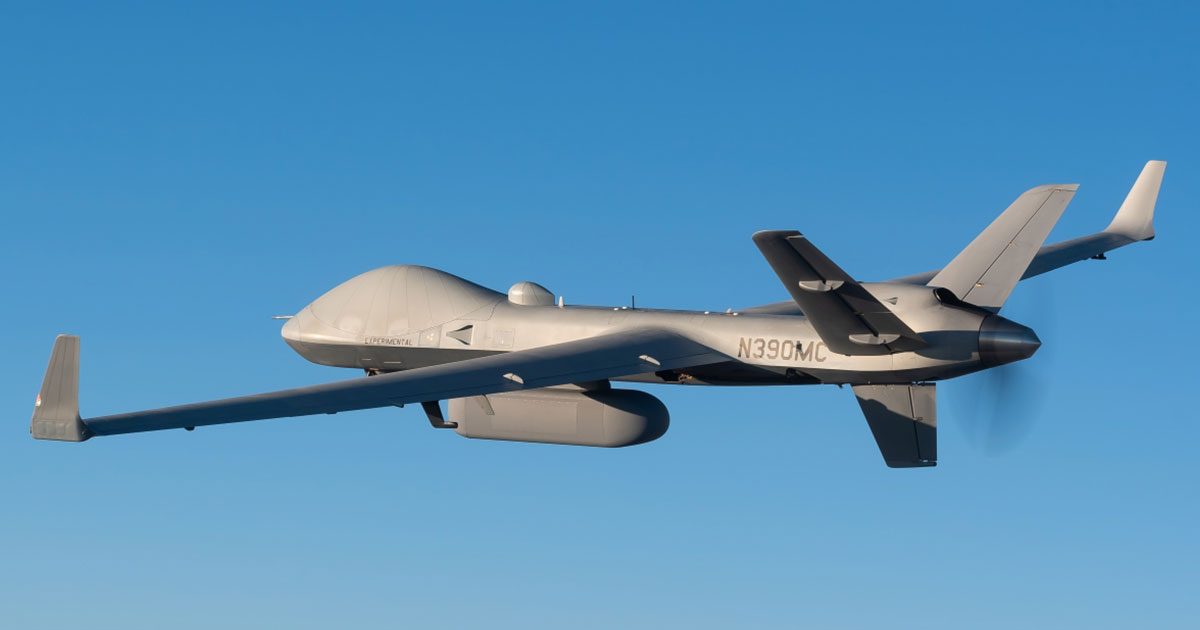
TOKYO — After a big earthquake or typhoon, the cell towers that survivors would use to call for help are often among the first things to fail. SoftBank Corp. and General Atomics Aeronautical Systems say they have now hung a working cell site under a coast guard’s long-endurance drone. On October 1, 2026, GA-ASI announced a completed flight test of SoftBank’s Disaster Relief Unit pod, or DRU Pod, on its MQ-9B remotely piloted aircraft. A day later, SoftBank published the results: flying a circuit 3,000 meters above the coast of Kuroshio Town in Kochi Prefecture, the aircraft put a mobile coverage area more than 5 kilometers across on the ground.
What is new is the platform. The aircraft was a SeaGuardian, the maritime version of GA-ASI’s MQ-9B, owned by the Japan Coast Guard and lent to the trial through cooperation between that agency and Japan’s Ministry of Internal Affairs and Communications. A remotely piloted aircraft system, or RPAS, is flown by a crew on the ground and can stay up far longer than a helicopter. SoftBank says this is the first time in Japan that mobile service has been provided from the air using a Japanese-designed and Japanese-built pod made for a large RPAS. That is the company’s own claim, based on what it says was public as of October 2.
“DRU lets an MQ-9B serve as a mobile network relay tower in the sky,” GA-ASI wrote. Its president, David R. Alexander, said the company believes “this capability will be of interest to many of our MQ-9B operators for disaster relief and emergency communications applications.” GA-ASI dates the integration flight to July 27.
The radio design works in two hops. On the ground, SoftBank set up a gateway: an LTE base station, the same kind of equipment behind ordinary 4G phone service, plus a frequency-conversion repeater. The gateway shifts the base station’s 2.1 GHz signal up to 3.3 GHz and beams it to the aircraft. Engineers call that leg the feeder link. Relay equipment in the pod shifts the signal back down to 2.1 GHz and broadcasts it to phones below, which is the service link. Because the pod has to keep both antennas pointed while the aircraft banks around its circuit, SoftBank mounted them on gimbals, motorized mounts that correct for the aircraft’s attitude in real time. The company says they kept tracking through the circular flight.
Outdoors, SoftBank measured up to 20 megabits per second downloading and 5 megabits per second uploading in a 5 MHz channel. SoftBank argues it is enough for what people need first after a disaster: telling family they are safe, and letting local governments and rescue agencies send photos and video of the damage.
Much of SoftBank’s account is about certification rather than radio. The pod was built in Japan to GA-ASI’s design data and quality requirements. It went through conformity checks on materials, manufacturing, and configuration, then thermal and electromagnetic-compatibility evaluation for integration. Ground and flight safety tests followed, confirming the pod did not upset the aircraft’s stability, handling, vibration, or existing systems. GA-ASI then granted airworthiness approval for the aircraft configuration carrying the pod. That approval is what let the communications flights happen at all.
The trial is one step in a longer program. In March 2026, SoftBank flew a DRU Pod on a helicopter off the same town. The work is funded as a research project selected in 2023 under the Beyond 5G (6G) Fund Program, which the communications ministry runs through the National Institute of Information and Communications Technology.
None of this is a fielded service yet. SoftBank calls it a verification trial and says it will use the data to refine the pod and work out how it would actually be operated in a disaster. GA-ASI notes that MQ-9Bs already fly with the United Kingdom, Belgium, and the Japan Coast Guard, and have been selected by Canada, Denmark, Poland, Germany, Qatar, Taiwan, and India. Each of those is a fleet that could, in principle, carry the same pod. Military & Aerospace Electronics and Telecompaper also reported the test.