
Technology Report
October 27, 2026
NFRI Visual-Enhancement Thermal Camera
ASAN, South Korea — A thermal camera is supposed to be the one tool that lets a firefighter see through smoke. In a dense, smoldering room fire it often is not: thick smoke and the soot and gases from incomplete combustion can wash a thermal image out to a flat gray, hiding the person a crew is looking for. On October 27, 2026, South Korea’s National Fire Research Institute, part of the National Fire Agency, announced that it has put a handheld camera built to fix that into service at four fire stations across the country, where firefighters will use it on real fires, rescues and training through November 27.
The agency calls it a “visual-enhancement thermal imaging camera for firefighting.” It was developed with the Korea Electrotechnology Research Institute (KERI), a government research institute. What the agency says is new is the processing, not the sensor. The camera works in long-wave infrared, the 8-to-14-micrometer band in which objects give off heat without any outside light, the band ordinary firefighting thermal cameras also use. KERI’s contribution is a smoke-removal image-enhancement method that runs on an FPGA (field-programmable gate array), a chip whose internal circuits can be reconfigured to run one specialized algorithm very fast. According to the agency, it cleans up every frame in real time, at 60 frames per second, with a delay of no more than one-thousandth of a second, so the firefighter is not watching a lagging picture. The agency says the chip was chosen to keep power draw and heat low enough for a small battery.
The result, the agency says, is that the outlines and details of people and obstacles hidden behind heavy smoke show clearly on the screen. In comparison images the agency released with the announcement, two unnamed commercial thermal cameras show little more than gray in a simulated extreme-smoke room, made by burning plastic foam and rubber, while the enhanced camera shows two mannequins standing in the room. The agency has not published test numbers such as detection range or image-contrast measurements, and the commercial cameras are identified only as Company A and Company B.
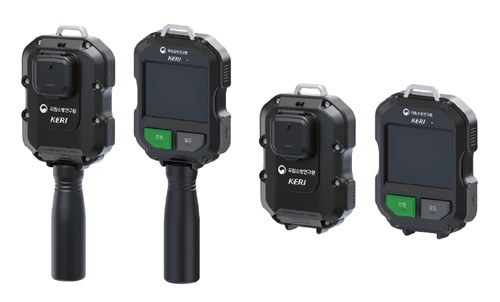
The trial unit is a second generation. The institute first developed the camera in 2023, and firefighters who tried it asked for something smaller. According to the agency, the new version is 66 percent smaller by volume, down from 4,475 to 1,503 cubic centimeters (about 273 to 92 cubic inches), and 64 percent lighter, down from 1,280 to 456 grams (about 2.8 pounds to 1 pound). It has a detachable handle, an IP67 rating, meaning it is sealed against dust and can survive brief immersion in water, and controls the agency says can be worked by feel while wearing thick firefighting gloves. Agency images show a rectangular body with a screen and two large buttons that can be carried with or without its pistol grip.
“Securing visibility even one second sooner at a fire scene filled with dense smoke is key to protecting firefighters and to securing the golden hour for rescuing people,” said Kim Yeon-sang, head of the institute. He said the trial will be used to check how useful the camera is in the field.
The four stations were chosen for their call volume and training schedules, the agency says, but it has not named them. Firefighters will rate the camera on mobility, ease of use and the quality of the enhanced image, and the institute says that feedback will shape a final design and a planned wider rollout. The agency has not said who would manufacture the camera, what it would cost, how long its battery lasts or when a national rollout might begin.