
Technology Report
September 19, 2026
Tianmushan-9
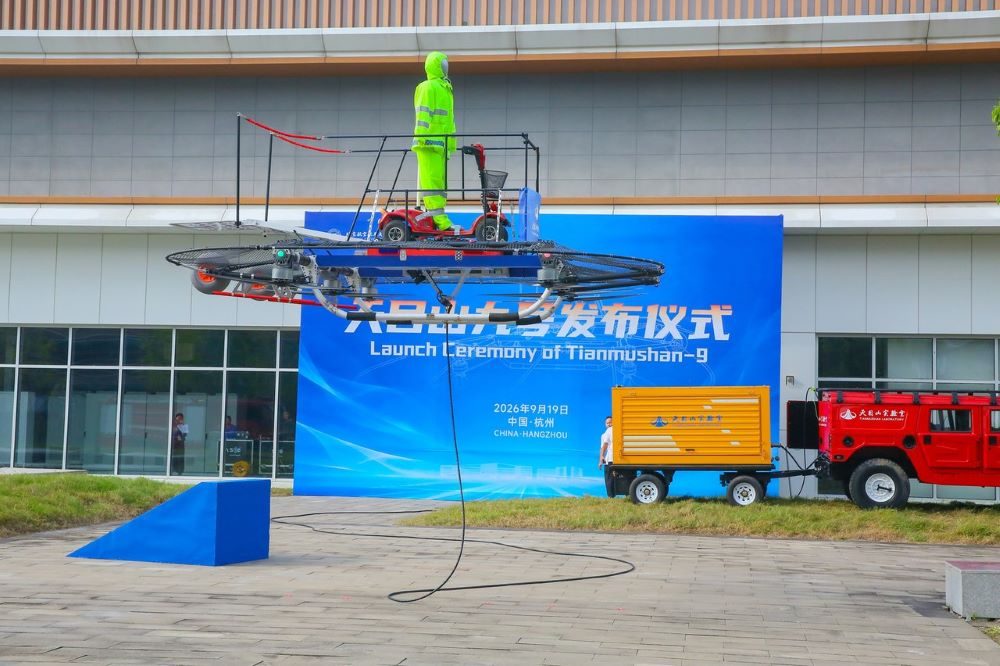
HANGZHOU — When a fire ladder cannot reach a floor, the usual options shrink. On September 19, 2026, Hangzhou-based Tianmushan Laboratory and its joint laboratory with Beijing-based Tianxun Innovation formally released Tianmushan-9, a vehicle-mounted tethered flying platform meant to put a standing work surface outside a high-rise window or balcony and keep it there on power from the ground.
A tethered aircraft draws electricity through a cable instead of relying only on batteries. The laboratory says that is what lets the platform hover for a long rescue rather than a short photo flight. Official Chinese coverage and English reporting by The Yangtzeer describe a system in four parts: the flying rescue platform, an 800-volt high-voltage tether supply, a modular transport-and-command vehicle, and an intelligent mission-control module. Takeoff can be from an SUV roof or from about 30 square meters of ground, they say — less space than a conventional aerial ladder truck needs.
The claimed working height is up to 100 meters. The platform is sized for three adults at once. Coverage from China News Service and Tide News says it can also deliver tools or supplies, or carry break-in gear to floors a ladder truck cannot reach. Those figures are the developers’ claims from the release day, not an independent test report.
The release included a staged rescue. Black smoke was set on a laboratory rooftop. The platform lifted a search-and-rescue robot dog to the roof, held a hover on the tether, and later carried simulated survivors back to the ground. Tide News reported that the dog’s search software came from an artificial-intelligence platform at Beihang University’s Hangzhou international campus. Flight control during the demo was described as semi-automatic, with a pilot in the loop.
The hard engineering step the team says it has already cleared is continuous 800-volt power over the tether. After about a year of work, empty-airframe and partly loaded flights, and vehicle-mounted takeoff and landing, have been demonstrated, according to the China News Service account. A July stage review, the same coverage says, closed out overall design, structure, propulsion, flight control, high-voltage power, and the command vehicle. Rescue mission modules and how the system fits different emergency scenes were still unfinished then.
What the platform does not have yet is a finished certificate. Tianmushan Laboratory says the next work is wall-side flying and uneven loads, then closer runs with emergency-management authorities and fire-rescue units on the way to final certification, mass production, and upgrades. Until that finishes, Tianmushan-9 is a demonstrated prototype, not equipment a department can treat as fielded.
The release closed the laboratory’s first batch of thirteen “signature” low-altitude projects, Tide News wrote, and framed the craft as an answer to dense urban fires where smoke, limited ground space, and ladder height cut off ordinary aerial access. Hangzhou.net also covered the debut the next day.