
Technology Report
October 23, 2026
tmsuk Water-Discharge Robot
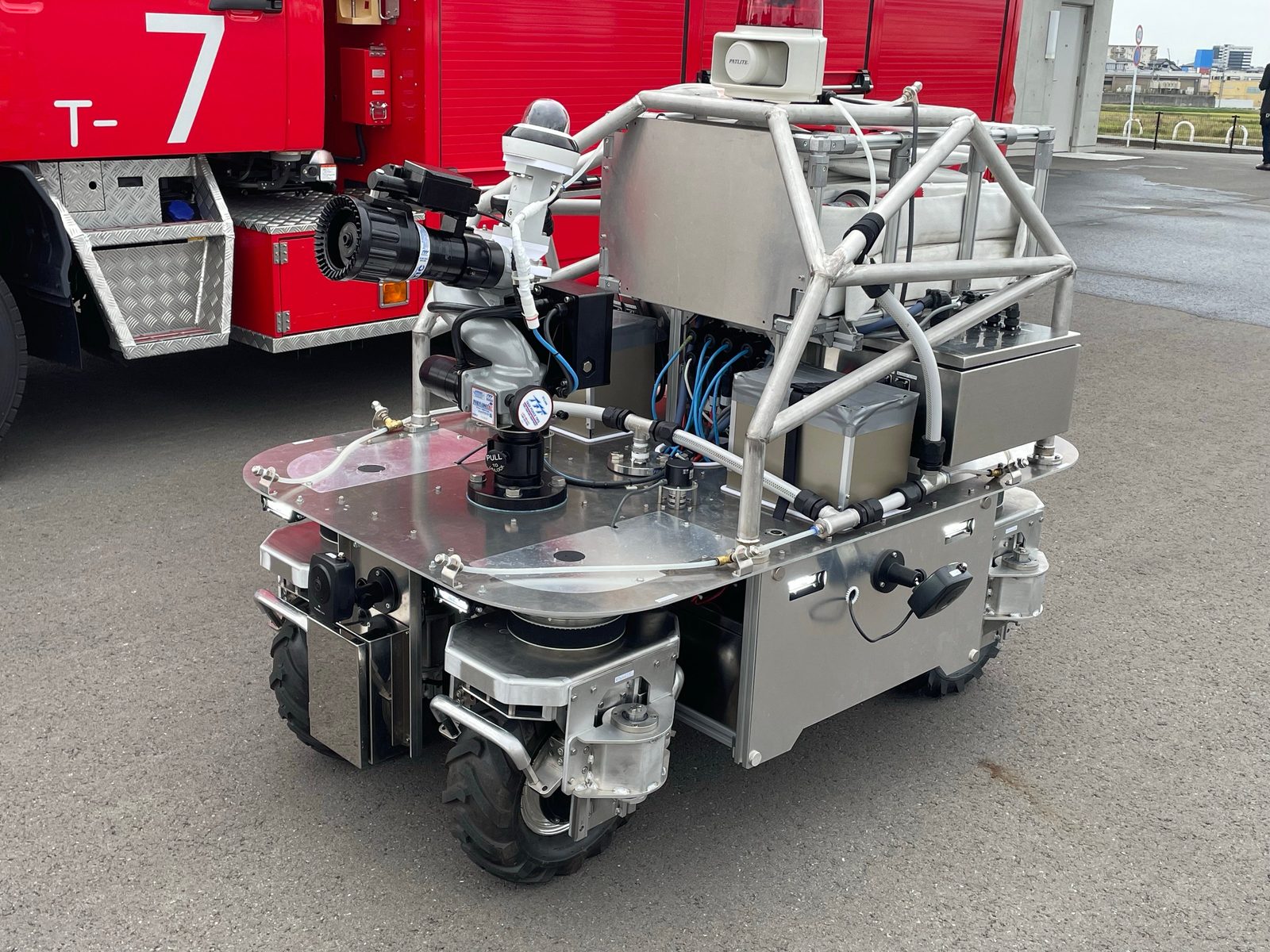
FUKUTSU, Japan — When fires broke out in Wajima after the January 2024 Noto Peninsula earthquake, firefighters faced a problem no hose could fix: parts of the burning city lay inside a zone where a tsunami warning was in effect, and crews had to fight fire in areas expected to flood. On October 23, 2026, the Kyoto robot maker tmsuk unveiled a prototype built for that situation, a remote-controlled water-discharge robot small enough to fit down a narrow side street and to ride to a fire on vehicles a fire department already owns. It was shown at Fukutsu Fire Station in Fukuoka Prefecture.
The machine’s Japanese name translates roughly as “small unmanned mobile water-discharge robot.” It was developed with the Munakata District Fire Department, which covers the coastal cities of Munakata and Fukutsu, and with Hisanori Amano, a former senior researcher at the Fire Research Center of the Fire and Disaster Management Agency’s Fire and Disaster Management College who now heads the robotics department at Tokushima Bunri University. The project was selected under the agency’s Fire and Disaster Management Science and Technology Research Promotion Program, a competitive research fund, in its fiscal 2025 call. According to tmsuk, the agency issued that call specifically to address firefighting in tsunami-warning areas after the Wajima fire.
What tmsuk says sets the robot apart is its size and how it handles hose. Most of the work is done by a water cannon, the large swiveling nozzle firefighters call a monitor, mounted on a four-wheeled chassis. The company says the nozzle can aim up, down, left and right and can sweep back and forth across a set angle on its own. Water comes from a fire engine through a hose connected at the rear, a TNC reporter explained on site. The robot also carries a hose box with several lengths of hose, so it can drive forward with the line still attached and extend its reach without a firefighter walking beside it to connect sections. To keep the robot from being damaged by the heat, it sprays itself with a protective water mist, which tmsuk says also lets it serve as a long-running unmanned nozzle so firefighters no longer have to hold a hose for hours and can turn to rescue and evacuation.
According to the release, the prototype is 1.5 meters (about 4 feet 11 inches) tall, 1.0 meter (3 feet 3 inches) wide and 1.7 meters (5 feet 7 inches) long, and weighs 460 kilograms (about 1,010 pounds) with its hose box. NHK reported the weight as about 430 kilograms. The company says the weight and suspension are what let the robot stay put while firing water in any direction, and that its large tires relative to its size help it cross rough ground. It runs on a 48-volt, 60-amp-hour lithium iron phosphate battery, carries five cameras, and is driven by an operator with a wireless controller over a local Wi-Fi link.
Size was a deliberate choice. “If it were big, it would be hard to get it to a disaster site right away when something happens,” a tmsuk director told the Fukuoka broadcaster TNC (TV Nishinippon). “At this size, it can go straight onto the transport vehicles a fire department already has.” The station also reported that, despite its many functions, firefighters can learn to operate it in a few hours. In the demonstration, firefighters ran the robot by remote control against a simulated fire at a site where hazardous substances could be released.
The robot comes from one of Japan’s longest-running disaster-robot programs. tmsuk says it began building rescue robots after the 1995 Great Hanshin earthquake in Kobe, when the Kitakyushu City Fire Department, which had sent crews to the disaster, asked for a machine that could work in places where secondary collapse made rescue too dangerous for people. That request led to the company’s Enryu series of heavy rescue robots.
This is a prototype, not a product. tmsuk says it will work with the Munakata District Fire Department this fiscal year to bring the robot to a level ready for adoption, followed by trial use on real fires, with full operation targeted in about two years. TNC reported that the developers first plan to improve its heat resistance. The release gives no heat-tolerance rating, flow rate, radio range, operating time per charge or price. Longer term, the company says it wants to add AI so the robot can take spoken orders from firefighters and work on its own, with several units holding a fire line together. Those are goals the company has stated, not capabilities shown in Fukutsu.