
Technology Report
October 11, 2026
Vine Robot
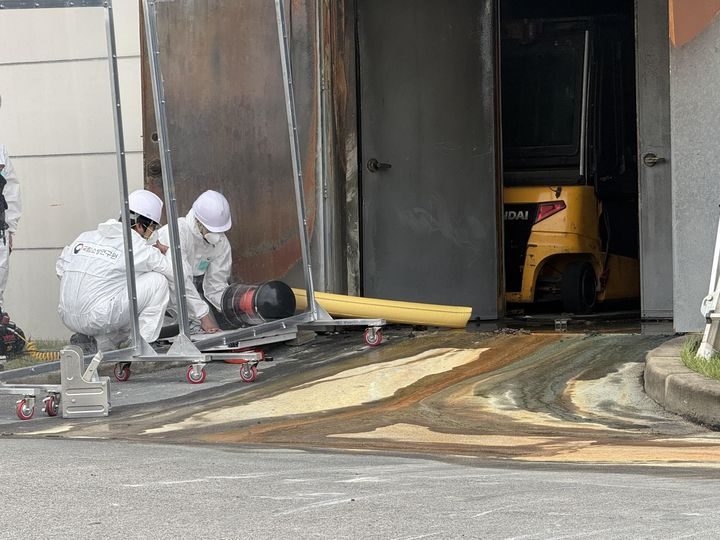
SEJONG, South Korea — For about two weeks this summer, Korean firefighters could not go inside a battery warehouse they had already put out. The danger was not the fire but what it left behind: tens of thousands of heat-damaged batteries that might set each other off if anything disturbed them. On October 11, 2026, Korea’s National Fire Agency said its National Fire Research Institute had sent in a soft “vine robot” from Professor Jee-Hwan Ryu’s team at KAIST, the Korea Advanced Institute of Science and Technology, and completed a reconnaissance of the interior that no crew or conventional robot could safely attempt.
What is new is the setting. Vine robots have spent most of their short history in laboratories and staged test rubble. This one went into a real incident, for a national fire agency, and it was picked for a reason specific to the hazard: it is light enough that moving across the floor would not set off the batteries lying there.
The fire broke out in August at the finished-goods warehouse of a factory in South Chungcheong Province that makes primary batteries, the single-use kind that cannot be recharged. According to the agency, the building did what it was designed to do. Reinforced-concrete construction, fire-rated partition walls, and automatic extinguishers on each storage shelf kept the fire from spreading through the building, and it was put out early. That early success caused the next problem. Of roughly 210,000 military battery packs stored inside, many had not burned but had been cooked by the heat. The agency says they were the same model as the batteries involved in the chain reaction at the Aricell battery plant in Hwaseong in June 2024, a fire that killed 23 workers.
The concern was thermal runaway. In a damaged cell, heat can trigger chemical reactions that release more heat, until the cell vents, burns, or explodes, and the heat it gives off can push neighboring cells into the same cycle. With that risk in mind, the agency barred anyone from entering for about two weeks after the fire was out, and crews could only watch from outside. The institute considered sending in a tracked robot or a four-legged walking robot, the usual choices for looking inside a dangerous building. It concluded that either machine’s weight bearing down on batteries left on the floor could start a new runaway.
A vine robot moves differently. Its body is a thin, flexible tube stored folded inside itself. When compressed air is pumped in, new material turns inside out at the tip, so the robot lengthens from the front the way a plant shoot grows, while the part already laid down stays put. Nothing has to roll, step, or drag across the floor, so the robot puts very little load on what lies beneath it and can snake through narrow gaps. The idea was introduced by Stanford researchers in a 2017 paper in Science Robotics. Ryu’s IRiS Lab at KAIST lists its version as a soft growing robot for exploration and rescue in confined spaces, and researchers at the University of Notre Dame and MIT Lincoln Laboratory have tested a similar robot in an engineered collapsed structure for urban search and rescue.
At the warehouse, the team set up a protective barrier outside the building. Operators in special protective gear steered the robot remotely from a safe zone while it grew into the interior, and the agency says it was able to confirm the state of things inside. The announcement did not describe what cameras or sensors the robot carried, how far it traveled, or what it found.
The institute says it will use the data from the mission to write a safe-reconnaissance manual for fires at large primary-battery sites, including military bases and industrial complexes, and to support the investigation into the fire’s cause. It also plans to feed the data into a disaster-robot development project that it and KAIST are jointly proposing to a national-security research program at MIT Lincoln Laboratory. That project is a proposal, not an award.
“We will take the requirements and difficulties of real fire scenes directly into robot development, and lead the way in advancing robot technology that keeps firefighters safe and supports their missions,” said Kim Yeon-sang, director of the National Fire Research Institute, in a statement translated from Korean. The government’s Korea.kr briefing room carries the agency’s release, and Yonhap and The Korea Times also reported the deployment.